
Mathematics is often seen as a world of formulas and equations, but it also contains fascinating puzzles that challenge our logical thinking. One of the most intriguing examples is the magic square—a numerical puzzle that has fascinated mathematicians, scholars, and puzzle lovers for centuries.
Among these, the 5×5 classic magic square is especially interesting. It is larger and more complex than the famous 3×3 magic square, yet it follows a beautiful mathematical pattern that anyone can learn.
In this guide, we’ll explore what a 5×5 magic square is, how it works, the pattern behind it, and how you can create your own. By the end, you’ll not only understand the concept but also be able to solve or construct one yourself.
What Is a Magic Square?
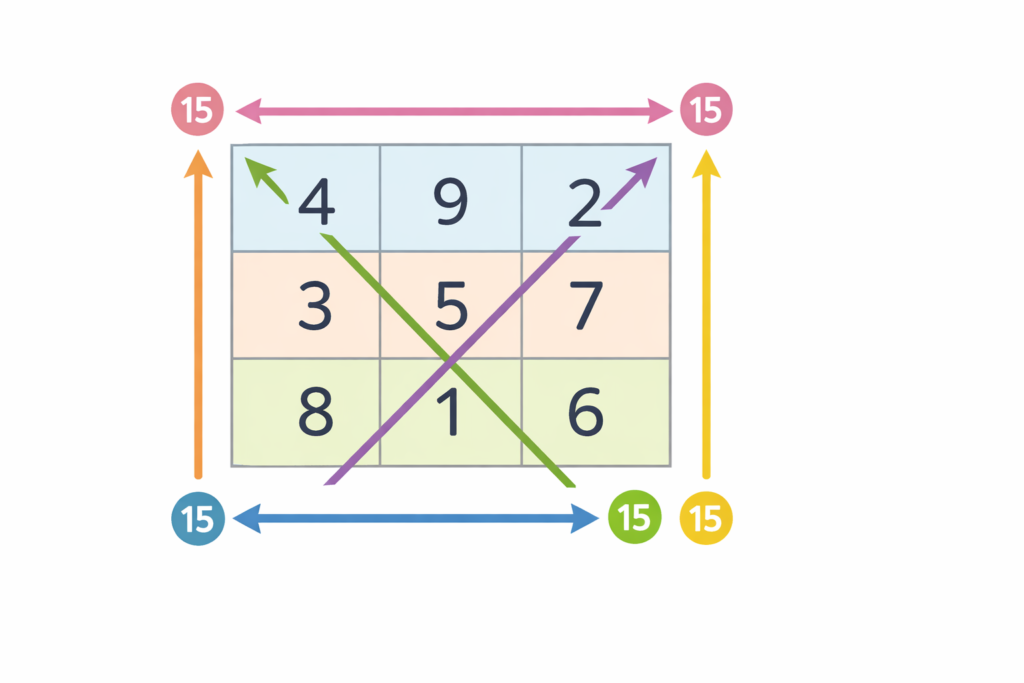
A magic square is a grid of numbers arranged in such a way that every row, column, and diagonal adds up to the same number, known as the magic constant.
Magic squares have appeared throughout history in many cultures. They were studied in ancient China, India, and the Islamic world, and later fascinated European mathematicians.
The simplest and most famous is the 3×3 magic square, where numbers from 1 to 9 are arranged so each row, column, and diagonal sums to 15.
However, when we move to a 5×5 grid, things become even more interesting.
Understanding the 5×5 Magic Square
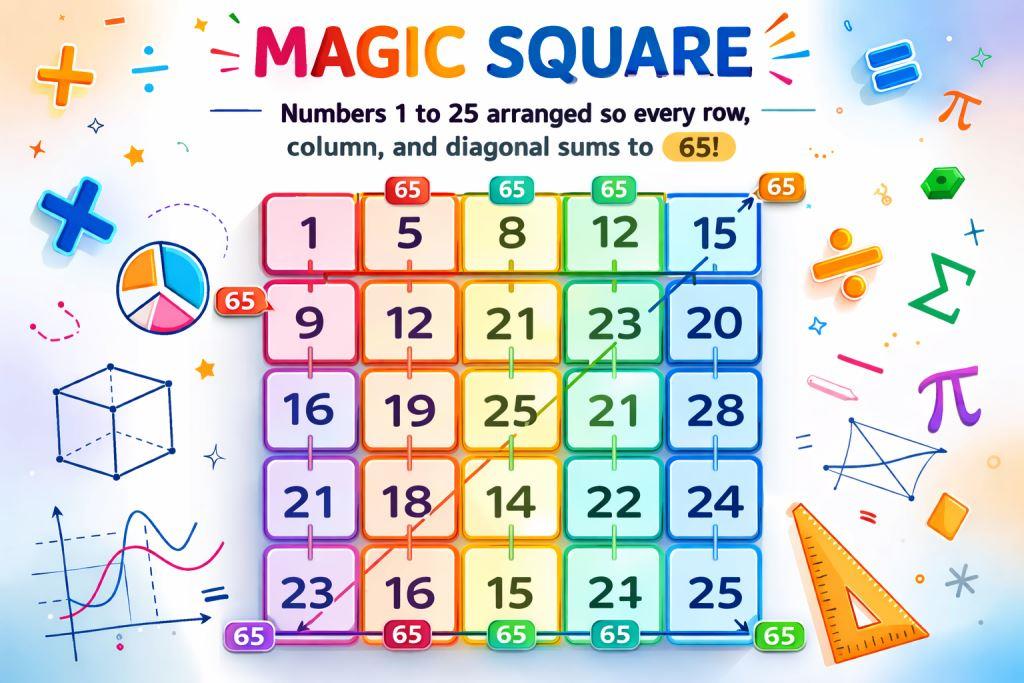
A 5×5 magic square contains the numbers 1 through 25, each appearing exactly once in the grid.
Since there are 25 numbers, the grid looks like this:
The goal is to place the numbers 1 to 25 so that:
- Every row has the same total
- Every column has the same total
- Both diagonals have the same total
That shared total is called the magic constant.
The Magic Constant for a 5×5 Square
Every magic square has a specific constant depending on its size.
For a square of size n × n, the magic constant is calculated using the formula:
[
M = \frac{n(n^2 + 1)}{2}
]
For n = 5, the constant becomes:
[
M = \frac{5(25 + 1)}{2}
]
Which simplifies to:
[
M = 65
]
This means:
- Every row sums to 65
- Every column sums to 65
- Every diagonal sums to 65
This symmetry is what makes magic squares so satisfying.
The Classic 5×5 Magic Square Example
Here is a well-known classic 5×5 magic square:
\begin{bmatrix}17 & 24 & 1 & 8 & 15 \ 23 & 5 & 7 & 14 & 16 \ 4 & 6 & 13 & 20 & 22 \ 10 & 12 & 19 & 21 & 3 \ 11 & 18 & 25 & 2 & 9\end{bmatrix}
Let’s verify a few sums:
Row example:
17 + 24 + 1 + 8 + 15 = 65
Column example:
17 + 23 + 4 + 10 + 11 = 65
Diagonal example:
17 + 5 + 13 + 21 + 9 = 65
Every direction produces the same result.
Why Magic Squares Are So Interesting
Magic squares are not just puzzles—they represent beautiful mathematical symmetry.
Some reasons they fascinate mathematicians and puzzle lovers include:
1. Perfect Numerical Balance
Every direction produces the same sum, which creates a sense of mathematical harmony.
2. Pattern Recognition
Solving or constructing a magic square requires identifying patterns rather than random guessing.
3. Brain Training
Magic squares improve:
- logical reasoning
- pattern recognition
- problem-solving skills
4. Historical Significance
Magic squares appear in many historical texts and works of art. They were once believed to hold mystical properties.
How to Construct a 5×5 Magic Square (Simple Method)
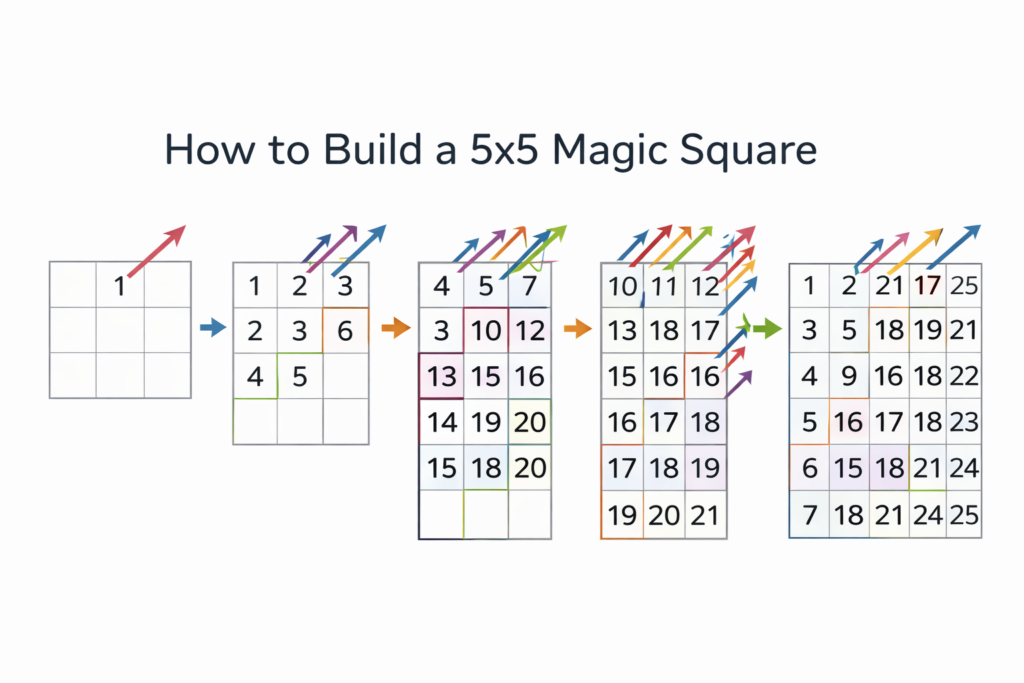
One of the easiest ways to build a 5×5 magic square is called the Siamese Method, which works for all odd-number squares.
Follow these steps:
Step 1: Start with the number 1
Place 1 in the middle cell of the top row.
Step 2: Move Up and Right
For each next number:
- move one row up
- move one column right
Step 3: Wrap Around the Grid
If you move outside the grid:
- going above the top brings you to the bottom
- going past the right edge brings you to the left side
Step 4: If a Cell Is Already Filled
Move one step directly downward instead.
Repeat this process until all numbers 1–25 are placed.
Eventually, you will create a perfect magic square where every line totals 65.
A Fun 5×5 Magic Square Challenge
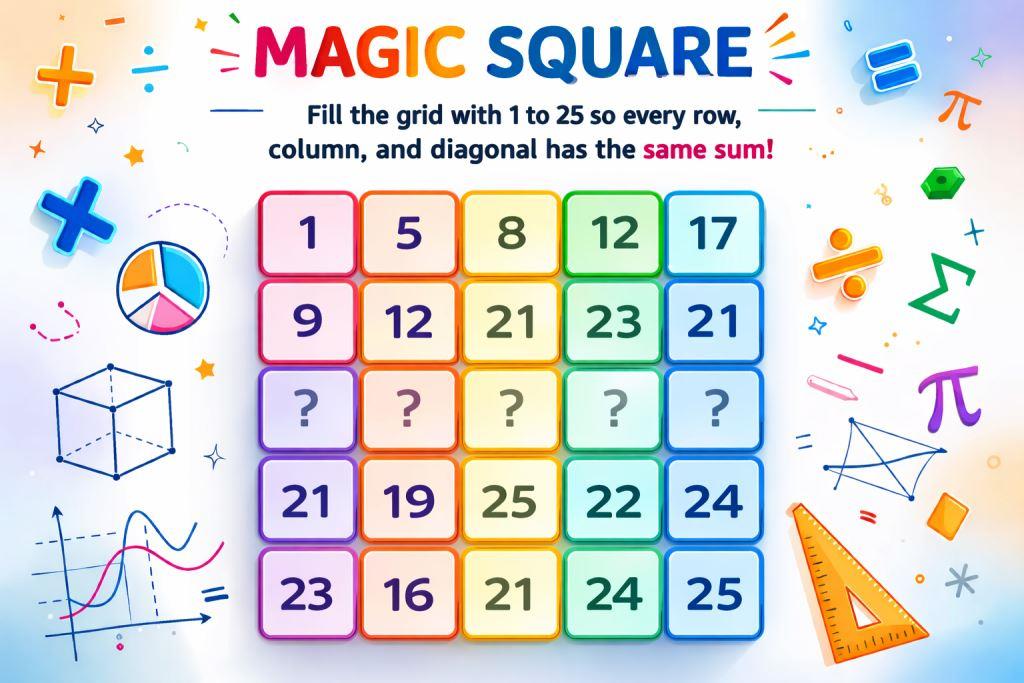
Try solving this incomplete magic square puzzle.
Fill the missing numbers so that every row, column, and diagonal equals 65.
| 17 | 24 | 1 | 8 | 15 |
|---|---|---|---|---|
| 23 | ? | 7 | ? | 16 |
| ? | 6 | 13 | 20 | ? |
| 10 | ? | 19 | ? | 3 |
| 11 | 18 | ? | 2 | 9 |
Hints:
- Use numbers 1–25 only once
- Check row totals
- Use column totals to eliminate possibilities
Puzzle lovers often find that logic works better than guessing.
Tips for Solving Magic Squares Faster
If you want to solve magic squares more efficiently, keep these tips in mind.
Look for Missing Numbers
Start with rows or columns that are almost complete.
Use the Magic Constant
If a row already contains numbers totaling 50, you know the missing value must be 15.
Focus on the Center
In odd-sized magic squares, the center number is always the average.
For 1–25, the center is 13.
Check Diagonals
Sometimes diagonals reveal missing numbers faster than rows or columns.
Educational Benefits of Magic Squares
Magic squares are widely used in education because they combine fun with mathematical learning.
Teachers often use them to help students:
- understand number relationships
- practice addition
- develop logical reasoning
- improve concentration
They are especially useful for middle school math enrichment activities.
Magic Squares in History
Magic squares date back over 2,000 years.
One of the earliest known examples comes from ancient China, known as the Lo Shu Square, a 3×3 magic square connected to Chinese mythology.
Later, magic squares appeared in:
- Islamic mathematical manuscripts
- Indian mathematical texts
- European Renaissance art
The famous German artist Albrecht Dürer even included a magic square in his 1514 engraving Melencolia I.
This shows that magic squares are not just puzzles—they are part of mathematical and cultural history.
Why Puzzle Lovers Still Enjoy Magic Squares
Even in today’s digital age, magic squares remain popular because they are:
- simple to understand
- challenging to solve
- satisfying when completed
They combine mathematics, logic, and creativity, making them appealing to both students and adults.
Many puzzle books, math competitions, and educational websites still feature magic squares as brain-teasing challenges.
Final Thoughts
The 5×5 classic magic square is a perfect example of how mathematics can be both logical and beautiful. By arranging the numbers 1 through 25 in a precise pattern, we create a grid where every row, column, and diagonal equals the same magical total of 65.
Beyond being a fun puzzle, magic squares help develop logical thinking, pattern recognition, and problem-solving skills. They also connect us to centuries of mathematical curiosity and creativity.
If you enjoy brain teasers, the 5×5 magic square is a fantastic challenge to explore. Try constructing one yourself using the Siamese method, or create your own puzzle to challenge friends and students.
Once you understand the pattern, you’ll realize that magic squares truly live up to their name—because the mathematics behind them feels almost magical.